
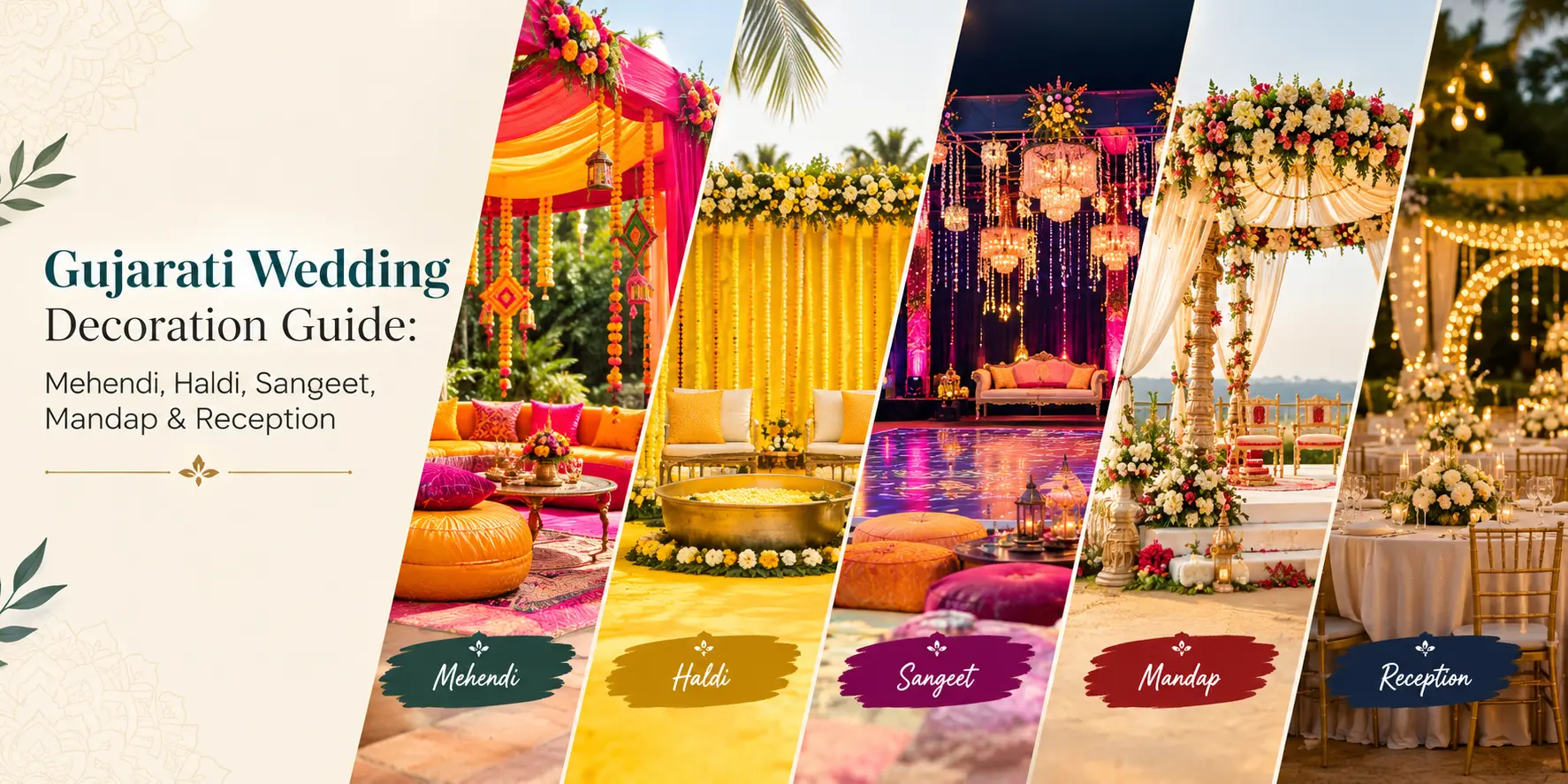
A Gujarati wedding is not one event. It is four or five days of separate functions, and each one has its own mood, its own rituals and its own time of day. The bright, playful set-up that works for Mehendi looks wrong around the sacred fire at the Mandap. The soft lights of a Sangeet night will not suit a 10 a.m. Pithi ceremony.
At Janta Decorators we have decorated weddings in Ahmedabad for more than 50 years. Families often come to us with one theme for the whole wedding. Our advice is simple: keep one colour story running through the days, but give each function décor that fits what happens there.
This guide walks through each function in order, with ideas you can use at a party plot, a banquet hall, a farmhouse or your own home.
Gujarati wedding decoration at a glance
| Function | Usual time | Colours that work | Key décor elements |
| Mehendi | Afternoon | Green, pink, orange | Low seating, bandhani drapes, umbrellas, floral swings |
| Pithi (Haldi) | Morning | Yellow, white, marigold orange | Marigold backdrop, banana leaves, brass urli, floor seating |
| Sangeet & Garba | Evening | Royal blue, magenta, gold | Stage, dance floor, fairy-light canopy, LED backdrop |
| Mandap & wedding | Day or evening (as per muhurat) | Red, white, gold, green | Four-pillar mandap, toran, entry gate, aisle, doli |
| Reception | Evening | Ivory, gold, pastels | Stage backdrop, couple seating, food canopy, warm lighting |
1. Mehendi decoration ideas
Mehendi is the most relaxed function of the wedding. The bride sits for hours while the artists work, and guests chat, eat and dance around her. The décor should feel colourful, comfortable and good in photos.
- Low seating (baithak): Gaddis, mattresses and bolsters in bright prints keep guests close to the bride. Add a raised, cushioned seat for her so the artist can work easily.
- Gujarati textiles: Bandhani and leheriya drapes, Kutchi mirror-work (abhla bharat) cushions and patchwork canopies give the space a true Gujarati look.
- Hanging umbrellas and parasols: A ceiling of colourful umbrellas gives shade at outdoor venues and makes a strong photo backdrop.
- Floral swing (jhoola): A swing wrapped in marigolds and roses is still the favourite seat for the bride’s photos.
- Photo corner: A small frame with a name board, colourful kites or a vintage bicycle with flowers gives guests a spot for pictures. Kites are a nice Ahmedabad touch, a nod to Uttarayan.
Tip: Plan shade and fans for daytime Mehendi. Even in winter, the afternoon sun at an open party plot can be strong.
2. Pithi (Haldi) decoration ideas
In Gujarati families the Haldi ceremony is called Pithi. Relatives apply a paste of turmeric, sandalwood and rose water to the bride and groom, usually in the morning at each family’s home. The décor is traditional, yellow and easy to clean.
- Marigold backdrop: Strings of yellow and orange genda flowers behind the seat are the classic Pithi look. Mix in mogra or white chrysanthemums so the photos do not turn all one shade of yellow.
- Natural elements: Banana leaves, mango leaf torans and coconut decor feel fresh and match the ritual.
- Seating: A low wooden patla or chowki for the bride or groom, with floor seating for the women of the family around it.
- Brass and copper: A brass urli filled with floating flowers, diyas and kalash pots look rich and need very little else.
- Splash-proof planning: Turmeric stains. Keep cloth drapes away from the main seat and use washable flooring or a disposable mat.
Tip: If the Pithi is at home, we can decorate the courtyard, the entrance and the balcony so a small space still looks festive.
3. Sangeet and Garba night decoration
No Gujarati wedding is complete without a night of Garba and Dandiya. This is where the décor has to handle hundreds of people dancing in circles, so open space and lighting matter more than props.
- A large, clear dance floor: Plan the floor first and place everything else around it. Garba needs a wide circle, not a narrow stage front.
- Stage for the singers and dhol: A raised stage with a printed or LED backdrop, plus room for the live band or DJ console.
- Lighting canopy: Fairy lights, hanging lanterns or a ceiling of string bulbs over the floor turn an open party plot into a festive space at night.
- Navratri-style touches: Colourful garba matkis (pots with diyas), chaniya choli prints on drapes and mirror-work panels connect the night to Gujarati tradition.
- Seating on the sides: Sofas and lounge areas for elders who want to watch, placed so they can see the dancers without blocking them.
Tip: Keep cables, speakers and generators well away from the dance circle. It is a safety point we check at every Sangeet we set up.
4. Mandap decoration and the wedding day
The Mandap is the heart of a Gujarati wedding. Hast Melap, the Mangal Feras around the sacred fire and Saptapadi all happen here, so this is where families should spend the most thought and budget.
The Mandap itself
- Four pillars, real meaning: A traditional Mandap stands on four pillars, often linked to the four parents or the four goals of life (dharma, artha, kama and moksha). Wrap them in flowers, carved wood panels or brass work.
- Colours of the bride’s outfit: Gujarati brides usually wear a red-and-white Panetar or a red-and-green Gharchola. A Mandap in red, white and gold, or red and green, matches the bride in every photo.
- Ceiling and canopy: A floral or fabric canopy with hanging flower strings frames the couple and the priest from above.
- Room for the rituals: Leave enough space for the havan kund, the priest, both sets of parents and the photographer. A Mandap that looks good empty but is too tight on the day causes problems.
Gate, entry and Jaan welcome
The groom’s procession (Jaan) arrives at the bride’s venue, where the bride’s mother welcomes him with the Ponkhvu ritual. A decorated entry gate, a toran of flowers or mirror-work over the doorway, and a flower-lined aisle to the Mandap make this moment special for both families.
Doli and Vidaai
For the Vidaai, we decorate the doli or the wedding car with fresh flowers and ribbons. It is the last photo of the wedding day, and families remember it.
5. Reception decoration ideas
The reception is the most formal event and often the one with the largest guest list. Guests spend most of their time in two places: the queue to meet the couple and the food area. Good reception décor makes both look and feel well planned.
- Stage backdrop: This is the main photo spot of the evening. Popular choices are floral walls, crystal and drape backdrops, panels with the couple’s initials, and themed sets such as royal, floral or modern minimal.
- Couple seating: A sofa or throne that suits the theme, with enough space on the stage for family group photos.
- Theme and colour: Many couples move to softer colours for the reception, such as ivory, gold, blush pink or pastel shades, as a change from the red of the wedding day.
- Food canopy: In Ahmedabad, food is a big part of every reception. A decorated food canopy with clear counters, lighting and signage keeps the dining area tidy and easy to move through.
- Lighting: Warm lights, chandeliers and uplighting on trees or pillars change how the whole venue feels after sunset.
Tip: Plan the guest queue to the stage. A short, decorated pathway with seating along the side stops the crowd from blocking the photographers.
Planning tips for a Gujarati wedding Decoration in Ahmedabad
- Book early for peak season. Most Gujarati weddings in Ahmedabad fall between November and February, and many families share the same muhurat dates. Book your decorator 3 to 6 months ahead for these dates.
- Fix the venue before the theme. A party plot on SG Highway or SP Ring Road, a banquet hall and a farmhouse each need different décor. An open party plot needs a full structure and lighting. A banquet hall already has a ceiling and walls to work with.
- Spend most on the Mandap and the reception stage. These are the two places that appear in almost every photo and video. Smaller functions can use simpler, reusable set-ups.
- Reuse décor between functions. Flowers, drapes and lights from one event can often be reworked for the next, which saves money when two functions are at the same venue.
- Share photos of what you like. Screenshots, Pinterest boards or photos from a wedding you attended help us understand your taste much faster than a written brief.
- Ask for a site visit. A good decorator will visit the venue, check power supply, entry points and set-up time before giving a final quote.
Plan your Gujarati wedding décor with Janta Decorators
Each function of a Gujarati wedding tells a different part of the story, from the fun of Mehendi and the colour of Garba night to the calm of the Mandap and the celebration of the reception. When the décor fits each moment, the whole wedding feels planned with care.
Janta Decorators has been part of weddings in Ahmedabad for more than 50 years. We handle Mandaps, stage backdrops, theme receptions, gate decoration, flower arrangements, food canopies and doli decoration, all under one team.
Frequently asked questions
What colours are used in Gujarati wedding decoration?
Red, white, green and gold are the traditional colours, matching the bride’s Panetar and Gharchola. Yellow and orange suit the Pithi, bright mixed colours suit Mehendi and Garba, and many couples choose ivory or pastels for the reception.
How many days before the wedding should the Mandap be set up?
The Mandap is usually ready a day before the wedding, especially when the family performs Mandap Mahurat and Ganesh Sthapana. Large outdoor set-ups at party plots can take two to three days.
Can one decorator handle all the wedding functions?
Yes. Using one decorator for every function keeps the colours and style consistent, makes it easier to reuse décor between events, and gives you one person to call.
How much does Gujarati wedding decoration cost in Ahmedabad?
The cost depends on the venue size, number of functions, flowers (fresh or artificial) and the theme. The best way to get a clear figure is a free site visit and quote.
Do you decorate weddings at home?
Yes. We decorate homes, society compounds and courtyards for Pithi, Mehendi and small family functions, as well as party plots, banquet halls and farmhouses.